
Garage Door Off-Track Repair in Southlake, TX
Call (817) 646-5612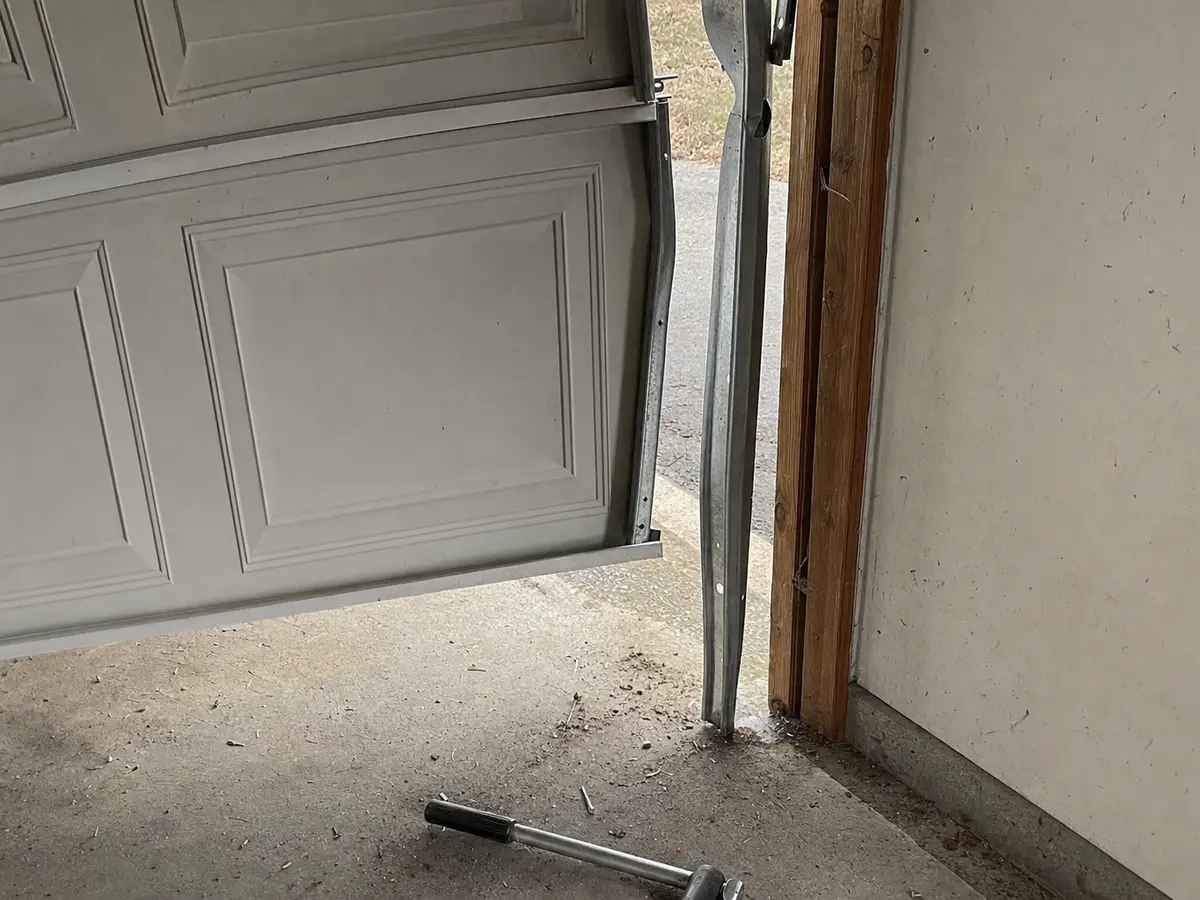
When your garage door jumps the track, it needs attention today. An off-track door does not close properly, which means your garage is not secure until it is fixed. We offer same-day off-track repairs in Southlake, TX and the surrounding area. Call us and we will give you a time window for today.
What an off-track door looks like
The door hangs at an angle. One side sits a few inches lower than the other, and the gap between the door and the frame is uneven on one side. You might hear a scraping or grinding sound when the opener tries to run. Sometimes the door moves a few inches and then stops completely. Other times it will not move at all.
A few things cause this. A broken cable is the most common reason. When a cable snaps, one side of the door loses tension and the panel shifts sideways off the rollers. Worn or cracked rollers can pull the door out of the track gradually, especially if the rollers have gone flat from years of use. A direct hit from a car bumper, even a light one, can knock a door off its lower track immediately. Years of track misalignment, where the vertical sections have slowly shifted out of plumb, will eventually do the same thing.
Whatever the cause, forcing the door is the wrong move. Pushing or pulling an off-track door bends the track further and can jam the door in a position where it cannot be closed at all. If the opener is still running with the door off-track, disconnect it before anything else. The red emergency cord hanging from the trolley releases the drive carriage. Pull it straight down, then leave the door where it is until we arrive.
How much does it cost to fix a garage door that is off track?
A straightforward off-track repair, rolling the door back onto its tracks and re-tensioning a cable, is the lower-cost end of this work in the Southlake area. If a roller needs replacing, that adds a little depending on the roller type and how many need to come out. Standard nylon rollers are inexpensive parts that we carry on the truck.
If the track is bent and needs straightening or a section replaced, the total runs higher and rises with the scope of the work. If the door came off because a cable snapped and the cable needs to be replaced and re-spooled correctly on the drum, the combined repair lands in a similar range.
What causes a garage door to come off its track?
The most common cause is a broken lift cable. Each side of the door has a cable that runs from the bottom corner bracket up to a drum above the door. When one cable snaps, that side loses tension and the panels shift sideways off the rollers. Worn or cracked rollers are the second most common cause. Rollers with flat spots from years of use no longer roll smoothly, and they catch and pull the door out of alignment gradually.
A direct hit from a car bumper, even a slow, light tap, can knock the bottom section off the lower track immediately. Years of gradual track misalignment, where the vertical sections slowly drift out of plumb, will eventually produce the same result. Temperature changes make all of these worse. Metal contracts in cold weather, and a track that is borderline in summer may bind completely on the first cold morning of the year.
How to fix a garage door that went off track?
Step one: stop using the door. Do not force it open or closed with the opener or by hand. If the opener is still running, pull the red emergency release cord hanging from the trolley rail to disconnect the drive carriage. If the door can be pulled to the closed position without forcing it, do that to secure the garage. If it cannot move without force, leave it where it is.
Step two: call a technician. Off-track repairs require a full inspection of both tracks, all rollers, and both cables before any realignment work begins. A door that went off track has an underlying cause. Putting it back on without finding that cause will produce the same failure again, often within days. This is not a DIY job — the door panels are heavy, the spring tension is still present, and forcing a misaligned door can bend the track into a condition that makes the repair more expensive.
How we fix it
When we arrive, the first thing we do is take the door off the opener drive if it is still engaged. This prevents accidental movement while we work. We then inspect the full length of both tracks, all the rollers, and the cables on both sides. A door does not go off-track randomly. There is always a mechanical reason, and we find it before we touch anything else.
If the track is bent, we straighten the section or replace it. Straightening works when the bend is minor. A badly crimped track section needs to come out because it will keep catching the rollers. If rollers are cracked, chipped, or flat-spotted, we replace them. Standard nylon rollers are inexpensive parts and we carry them in the truck. If a cable pulled loose from the drum or snapped completely, we replace the cable and re-spool it correctly on the drum. A cable wound the wrong way puts uneven tension on the door and will pull it off-track again within weeks.
Balance is what we check hardest after the repair. With the opener still disconnected, we lift the door by hand and let go at the halfway point. A correctly balanced door holds there on its own; if it creeps up or sinks, the spring tension is off or something else is still wrong, and we keep adjusting until it holds. Only then do we reconnect the opener, cycle the door, and verify the auto-reverse before we leave.
Most off-track repairs take 45 minutes to two hours. The range depends on what caused the problem and whether parts need replacing. If your door needs a new cable along with the track work, that adds time. We will give you an honest estimate of both cost and time before we start.
Why this cannot wait
A door sitting off its tracks does not close flush with the frame. Even if it looks mostly closed, there is a gap somewhere. That gap is visible from outside and makes forced entry easy. If the gap is on a side that faces a street or alley, it is obvious to anyone passing by that the garage is not secured.
Beyond security, an off-track door puts uneven stress on the springs and cables. When one side of the door is carrying load that should be split between both sides, the components under stress wear out faster. The longer an off-track door runs in that condition, the more likely you are to have a second failure alongside it. A cable snapping under uneven load, or a spring breaking from carrying more than its share, turns a one-item repair into a two-item repair.
Cold weather tightens this timeline. Metal contracts in low temperatures, and a track that is borderline at room temperature may not move at all when it is cold outside. If your door went off-track in the winter, do not wait for it to warm up and see if the problem goes away. It will not.
What happens when a garage door leaves the track
A door off its track is not the same problem every time. Some doors slide partially out of the vertical section. Others derail completely at the top horizontal bend. The location of the derailment tells a technician which component failed and how much force was involved.
Standard residential tracks use a .875-inch gauge opening. Rollers with a worn or broken stem let the wheel drift sideways under load. When the stem snaps, the door drops on one side and jams. That is the most common pattern in Southlake.
In the Village of Stone Lakes corridor, a high percentage of homes have two-car doors 16 feet wide and 7 feet tall. Wide doors exert more lateral stress on the bottom bracket assembly. If one bottom bracket loosens, the cable goes slack on that side and the door tips out of track under the spring tension still pulling the other side up.
The Two Derailment Types We Repair
Partial derailment means the rollers are displaced but the door still spans the opening. The door is stuck. Full derailment means one or more sections have separated from the track entirely. That door needs support before the panels buckle from their own weight.
We assess severity before touching anything. A fully derailed door can fall. We use a C-clamp below the lowest displaced roller to hold position while we diagnose the cause.
What We Check During the Repair
We inspect the track itself. A track that bends more than 1/4 inch out of plumb along any 12-inch span needs replacement, not straightening. Straightened tracks return to the bent position under door weight within weeks.
We check all 10 to 12 roller stems on a standard 7-foot door. Nylon rollers with 13 ball bearings are rated for 10,000 to 15,000 cycles. Steel rollers without bearings are rated for closer to 5,000 cycles. Southlake homes near the Town Square corridor average 6 to 8 daily cycles, which puts a bearing roller set at roughly 5 to 7 years before replacement is due.
We check the bottom bracket bolts. The bracket takes the full weight of the door when the cable is under tension. Loose bolts are the single most common fixable cause of repeated off-track events in this service area.
Process Transparency
Step one: contain the door so it cannot fall further. Step two: identify the root cause (worn roller, bent track, broken bracket, or cable slack). Step three: repair or replace the failed component. Step four: manually cycle the door three times before reattaching the opener trolley. Step five: test the auto-reverse force setting on the opener to confirm the door stops within 2 inches of resistance.
We do not reattach an opener to a door that cycles unevenly by hand. An out-of-balance door damages the opener drive within weeks.
Why Stone Lakes Homes See This More Often
Construction in the Village of Stone Lakes ran from the mid-1990s into the early 2000s. Many original spring and roller assemblies are now 20-plus years old. Against a rated 10,000-cycle life per component, a door used about four times a day reaches that threshold in roughly seven years. Homes in this corridor that have never had a roller or spring service are statistically overdue.
The Southlake Town Square corridor adds another factor: commercial delivery traffic on adjacent streets vibrates the ground enough over years to loosen anchor bolts in garage walls. We see slightly higher track loosening rates near FM 1709 than in quieter residential pockets.
Off-track repairs in Southlake average 60 to 90 minutes when the cause is a single failed component. Multi-component failures (broken roller plus bent track section plus loose bracket) run 2 to 3 hours. We give a time estimate on arrival before any work starts.
Same-day garage door off-track repair available in Southlake, TX.
Call (817) 646-5612Serving Southlake, TX and Surrounding Areas
Also serving: Grapevine, Colleyville, Roanoke, Keller, Trophy Club, North Richland Hills, Bedford, Euless, Hurst
Need garage door off-track repair today?
Available today in Southlake, TX. We give you the price before any work starts.
Call (817) 646-5612