
Garage Door Cable Repair in Southlake, TX
Call (817) 646-5612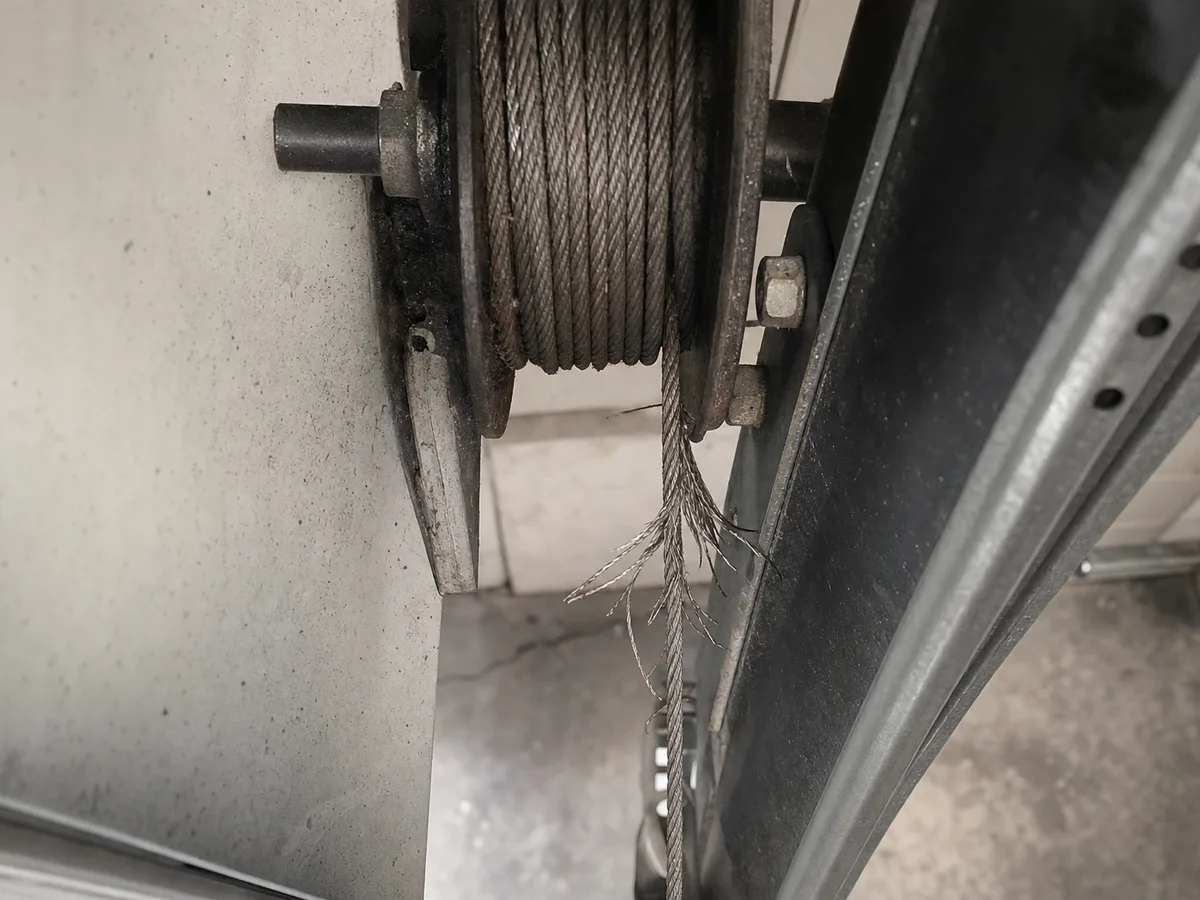
When a garage door lift cable snaps, one side of the door drops. The door hangs at an angle and will not travel correctly in either direction. Same-day lift cable repair is available across Southlake, TX. Do not run the opener or force the door by hand — leave it where it is and call us.
What a broken cable looks like
The door hangs lower on one side. The gap between the bottom of the door and the floor is uneven, with one corner down and the other up. If you try to use the opener, the motor may run but the door barely moves, or it grinds against the tracks where the misaligned panel is catching. You may see a loose cable hanging along the side of the door or curled up at the bottom of the track.
In some cases, the cable does not snap cleanly. It frays and unwinds from the drum over time. A frayed cable is harder to notice until it fails. Visible strands separating from the main cable, or a cable that looks kinked and discolored near the drum or at the bottom bracket, is a cable that is close to the end of its life.
Either way, snapped or frayed, the door should not be operated while the cable is compromised. A door traveling on one cable puts all the load on one side. That asymmetric load can bend the track, damage the remaining cable, and accelerate spring wear.
How lift cables work
Each side of the garage door has a steel cable that runs from a bracket bolted to the bottom corner of the door up to a drum mounted above the door on the spring shaft. When the door opens, the drums rotate and wind the cables, pulling the bottom of the door upward. When the door closes, the drums unwind and the cables feed out as the door descends.
The cables work in combination with the springs. The spring stores the energy to lift the door weight. The cables transfer that energy from the drum to the door panel. If a spring breaks, the cable loses the tension that keeps it properly wound on the drum and may slip or pile up. If a cable breaks, the spring is still under tension but has nothing to pull against on that side — the door drops.
This is why cable problems and spring problems often occur together or close together in time. When we arrive for a cable repair, we inspect the springs and drums on both sides before beginning work.
Why garage door cables break
Age and cycle count are the main factors. Standard residential lift cables are rated for thousands of cycles and typically last the life of the springs — seven to ten years on average. After that, the steel strands begin to fatigue at the points where the cable bends: at the drum, at the bottom bracket, and at the cable anchor. These are the spots to check first.
A spring that broke and allowed the door to drop suddenly puts immediate shock load on the cable. A cable that was intact before the spring failure may snap in the same event or be severely damaged. If you had a spring break recently and the door came down hard, both cables should be inspected even if the door appears to be traveling correctly.
Can you open a garage door with a broken cable?
You can attempt to lift it manually by disconnecting the opener drive (pull the red cord) and raising the door by hand. But a door with one broken cable will feel lopsided and resist smooth travel. If you manage to get it up, it may not stay up reliably — the spring tension is still present but now unbalanced.
Operating the electric opener with a cable problem is a worse option. The opener pulls against the door regardless of what the cable is doing, and it will either bind the door further into the track, damage the drive gear, or cause the remaining cable to fail as well. Disconnect the opener and leave the door in whatever position it is currently in until we can get there.
How much does garage door cable repair cost?
Cable replacement for a single side in the Southlake area includes parts and labor. We replace both cables when one fails, since cables wear at the same rate, and a cable that is near the end of its life on the other side is not worth leaving. A two-cable replacement on a standard door costs somewhat more, since both sides are done together.
If the cable failed because a spring broke, you are looking at a combined repair: cable plus spring replacement, with the total depending on the spring type and whether we are replacing one or both springs. We give you the full price before we start. If we find anything additional during the inspection, we tell you before touching it.
How we fix it
We arrive and inspect the full door system before touching anything — both cables, both drums, the springs, the bottom brackets, and the track. A cable that snapped often caused secondary damage when it went: a bent bracket, a dented track section, a drum that wound unevenly. We find those things before we start the repair so there are no surprises.
We replace the damaged cable with a correct-gauge replacement. Garage door cable diameter matters — a cable that is undersized for the door weight will fail quickly. We re-thread the cable through the bottom bracket, route it correctly, and wind it onto the drum with the right number of turns for the spring tension. An improperly wound cable produces uneven tension and will pull the door off-track.
With the new cable installed, we run the door through several full open-and-close cycles and watch how it tracks. An evenly wound cable keeps both sides level through the whole travel; if one corner leads or lags, the drum turns need correcting. We confirm the balance holds by hand and that the auto-reverse trips before we leave.
Garage door cable repair in Southlake: what cables do and why they fail
Lift cables do one job: transfer the spring force to the door. The torsion spring unwinds as the door opens, and the cables convert that rotational force into upward movement at the bottom corners of the door. A cable that breaks on one side drops that corner of the door instantly. The door becomes impossible to operate safely.
Standard residential lift cables are 1/8-inch aircraft-grade galvanized steel, rated to approximately 300 pounds breaking strength. On a 200-pound double-car door, that leaves a safety factor of 1.5 to 1. Cables under heavy load every day for 10-plus years work their way toward failure through metal fatigue, not through sudden overload.
North Texas Temperature Cycles and Cable Fatigue
Southlake sees big seasonal temperature swings across the calendar year, from cold winter mornings to hot triple-digit summer afternoons. Steel expands and contracts with temperature. A cable drum is a fixed-diameter cylinder. Each thermal cycle stretches the cable slightly at the drum groove where it wraps. Over years, that groove point becomes the weakest section of the cable.
North Texas averages 40-plus degree temperature swings between winter lows and summer highs within a single season. This is more thermal stress on cable metal than most northern states experience. We see cable failures in Southlake at a slightly younger average age than national industry data suggests.
Cables on the shaded (north) side of a door typically fail first. Less direct sun means more condensation, which accelerates corrosion at the drum groove.
Door Weight and Cable Selection
A standard 9x7 foot single-car steel door weighs 90 to 120 pounds. A 16x7 foot double-car steel door weighs 180 to 220 pounds. An insulated double-car door adds 30 to 60 pounds. We verify door weight before selecting replacement cable gauge.
For doors heavier than 250 pounds, we use 3/16-inch cable rated to 480 pounds breaking strength. This is uncommon in standard Southlake residential construction but present in some custom homes with custom oversized doors. We measure and confirm before pulling the cable off the truck.
The Repair Process Step by Step
Before touching the cable, we release spring tension. A cable replacement attempted with a loaded spring is dangerous. The tension must come off the spring first using winding bars. Then: clamp the door in place so it cannot fall while the cable is removed. Remove the old cable from the drum and bottom bracket. Thread the new cable through the bottom bracket slot and up to the drum. Wind the cable onto the drum with correct overlap, maintaining tension at the bottom bracket anchor. Release the clamps. Reload the spring to correct tension. Test door balance by hand before reattaching the opener.
This sequence is not optional. A cable installed without first releasing spring tension and without a balanced door test afterward will fail or cause opener damage.
Fraying: When to Replace Before It Breaks
A cable does not have to break to need replacement. Fraying is visible early. Individual wire strands separate from the main cable at the drum groove area. A cable showing 3 or more broken strands in any 6-inch section should be replaced. We check both cables on every service visit, not just the one that shows visible damage. Cables on both sides log the same cycle count.
We do not splice or weld broken cables. A splice point is weaker than the original cable rating. Replacement is the only correct repair for a broken or heavily frayed cable.
Cable Repair Time and Parts
Cable replacement on a standard door: 45 to 75 minutes. Both cables replaced simultaneously adds 20 to 30 minutes to the single-cable time. We carry 1/8-inch and 3/16-inch cable in standard lengths for 7-foot and 8-foot door heights. We cut to the exact length required on site.
Same-day garage door cable repair available in Southlake, TX.
Call (817) 646-5612Serving Southlake, TX and Surrounding Areas
Also serving: Grapevine, Colleyville, Roanoke, Keller, Trophy Club, North Richland Hills, Bedford, Euless, Hurst
Need garage door cable repair today?
Available today in Southlake, TX. We give you the price before any work starts.
Call (817) 646-5612